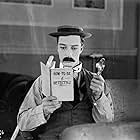
A film projectionist longs to be a detective, and puts his meagre skills to work when he is framed by a rival for stealing his girlfriend's father's pocketwatch.
Keep track of everything you watch; tell your friends.
If your account is linked with Facebook and you have turned on sharing, this will show up in your activity feed. If not, you can turn on sharing
here
.
Because the Baron of Chanterelle wants to preserve his family line, he forces his timid nephew Lancelot to choose one of the village maidens to wed. Lancelot flees to a monastery to escape ... See full summary »
A surreal, virtually plotless series of dreams centered around six middle-class people and their consistently interrupted attempts to have a meal together.
Director:
Luis Buñuel
Stars:
Fernando Rey,
Paul Frankeur,
Delphine Seyrig
A projectionist is studying to be a detective and is in love with a young lady. When he proposes her, his rival steals the chain watch of her father and incriminates him. The disappointed young projectionist returns to his job and while projecting the film, he dreams on being the detective of the story. Meanwhile, the girl finds the truth and acquits the guilty of the projectionist to her father. Written by
Claudio Carvalho, Rio de Janeiro, Brazil
Following his "entrance" into the "movie within a movie," the scenery changes around Buster Keaton very quickly, as if the movie is changing scenes with quick edits. (He suddenly finds himself on a crowded city street, in the jungle confronted by lions, on a rock in the middle of the ocean, etc.) Keaton later recalled that his cameraman, Byron Houck, had used surveying instruments to position him and the camera at the exact correct distances and positions to give the illusion of continuity as the scenes changed. See more »
Goofs
After Sherlock Jr spins the fence around placing his pursuers behind it, he puts a crossbar across the gate to stop them coming back. In the next shot as he leaves the alley, the crossbar is no longer visible on the fence. See more »
Quotes
The sheik:
[to Sherlock Jr. about a man locked in a tight cage]
That's a detective. When he's dead I'll put you in there.
See more »
This Keaton classic is both funny and extremely clever in its construction. Our hero is a cleaner but dreams of becoming a detective, always with his nose buried in a book on the subject.
The first third of the film is much like any other comedy. There are lost dollar bills, things sticking to other things, something stolen, mistaken identities. Our heroine is introduced in a charming scene where they seem terrified to hold hands. Her father is played by Buster's father Joe Keaton, who would appear in many of his son's films.
There's a mustachioed cad with slick hair and a sharp suit who is after the girl, a cartoon baddie who the audience instinctively knows deserves a hiss and not a cheer.
It is in Junior's other job as a cinema projectionist that the film comes alive. We are watching the film he has set up and then, suddenly, he is part of the action. In a sequence of great inventiveness, we see the film within a film changing scenes and watch with delight as the character adapts to each situation and surrounding.
Sherlock Jr is very funny but is also unusual and, in comparison with other comedies of the period, ahead of its time. It includes some excellent stunts that are the equal of anything done by Harold Lloyd in the same period, and, although it has a very short running time, manages to develop a good storyline throughout.
Justly feted as a masterpiece of silent comedy, Sherlock Jr represented one of the peaks of Buster Keaton's cinematic career. It is a film worth watching and has stood up well today.
13 of 15 people found this review helpful.
Was this review helpful to you?
This Keaton classic is both funny and extremely clever in its construction. Our hero is a cleaner but dreams of becoming a detective, always with his nose buried in a book on the subject.
The first third of the film is much like any other comedy. There are lost dollar bills, things sticking to other things, something stolen, mistaken identities. Our heroine is introduced in a charming scene where they seem terrified to hold hands. Her father is played by Buster's father Joe Keaton, who would appear in many of his son's films.
There's a mustachioed cad with slick hair and a sharp suit who is after the girl, a cartoon baddie who the audience instinctively knows deserves a hiss and not a cheer.
It is in Junior's other job as a cinema projectionist that the film comes alive. We are watching the film he has set up and then, suddenly, he is part of the action. In a sequence of great inventiveness, we see the film within a film changing scenes and watch with delight as the character adapts to each situation and surrounding.
Sherlock Jr is very funny but is also unusual and, in comparison with other comedies of the period, ahead of its time. It includes some excellent stunts that are the equal of anything done by Harold Lloyd in the same period, and, although it has a very short running time, manages to develop a good storyline throughout.
Justly feted as a masterpiece of silent comedy, Sherlock Jr represented one of the peaks of Buster Keaton's cinematic career. It is a film worth watching and has stood up well today.