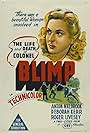
From the Boer War through World War II, a soldier rises through the ranks in the British military.From the Boer War through World War II, a soldier rises through the ranks in the British military.From the Boer War through World War II, a soldier rises through the ranks in the British military.
- Awards
- 1 win & 2 nominations


- von Reumann
- (as Carl Jaffé)


- Directors
- Writers
- All cast & crew
- Production, box office & more at IMDbPro
Storyline
Did you know
- TriviaWinston Churchill hated the film and wanted it banned. Failing that (for legal reasons), he tried to keep it from being exported because he thought it was a threat to wartime morale, and he also failed at that.
- GoofsWhen the two dogs are let into the London house, one can be seen at the top of the stairs answering a call of nature.
- Quotes
Theo Kretschmar-Schuldorff: You know that, after the war, we had very bad years in Germany. We got poorer and poorer. Every day retired officers or schoolteachers were caught shoplifting. Money lost its value, the price of everything rose except of human beings. We read in the newspapers that the after-war years were bad everywhere, that crime was increasing and that honest citizens were having a hard job to put the gangsters in jail. Well in Germany, the gangsters finally succeeded in putting the honest citizens in jail.
- Crazy creditsDeborah Kerr's characters are listed separately, in order of appearance, so her name appears three times in the movie credits.
- Alternate versionsThe original version (the one restored to Criterion Collection DVD and laserdisc) runs 163 minutes. When Winston Churchill expressed his vehement dislike for the film, the British distributor, Rank Films, cut it to 140 minutes. The film was chopped to pieces when it was imported to the United States in 1945, running around 120 minutes (in which the film's vital flashback structure is eliminated and the story is told from beginning to end). The film was further cut to 90 minutes and ran on public television often in the 1970s; for years, it was thought that this was the only extant version. In 1983, with the cooperation of the Archers, the film was restored to the full 163-minute length. The restored film retains the original flashback structure and many World War I scenes, including the appearance of a black soldier.
- ConnectionsFeatured in Arena: A Pretty British Affair (1981)
An early British venture into the new Technicolor process, "Blimp" is an unmitigated triumph. Georges Perinal, for the Technicolor Company, produced a sumptuous and crystal-clear stream of images. The pastel blue of the Turkish baths and the pinks and reds of the British Embassy are a feast for the eye. And it is hard to think of many finer cinematic moments than Edith's appearance at the hospital window, her face dappled by leaf shadows and her vivid scarlet belt radiant with colour.
The brisk pace of the action is set right at the very beginning, with a team of motor-cycle couriers being passed at speed by the truck-mounted camera. We see a message being delivered to a young army officer. Dialogue is delivered in amusing staccato, and the officer, 'Spud' Wilson, launches a military manoeuvre. His men set off in pursuit of a uniformed young woman, referred to as 'Mata Hari'. This puzzling business engages our attention, but we have to wait until the final reel for everything in this section to be explained.
A skilful transition takes the camera by means of a crane shot to the far end of the pool in the Turkish baths, and we have travelled back in time from 1943 to 1902. The gentlemen's club is exactly the same, this being England, land of enduring values. There are comforting references to Albion's might, for this is Britain's heyday and the Boers have just been defeated. Young Candy is correspondingly vigorous, just back from South Africa with his Victoria Cross. A letter from an English governess living in Germany sends Candy off on a bit of proto-Bond counterespionage. Those German bounders must be prevented from spreading lies about Britain's record in South Africa. The British, unlike the beastly hun, always fight fair.
The German episode culminates in Candy fighting a duel with Kretschmer-Schuldorff, befriending him then losing Edith to him. This section of the film is packed with unflattering German stereotypes. Kaunitz and his 'table' stop the playing of the operetta tune - German militarists, you see, are killers of beauty. Whereas London was reassuringly sooty and foggy, Berlin is all snow trodden by jackboots - a harsher political climate. The meticulous care the German officers take over the duel arrangements emphasises their devotion to violence and their lack of humanity. A second beautiful transition lifts us out of the Uhlans' gymnasium and into a carriage.
Quite apart from boosting morale at home in Britain, this movie was also intended to encourage sympathy for the British cause in the USA. Accordingly, some blatant Americanisms have found their way into the script ('went bail', 'railroad', 'we're quits'). Kretschmer-Schuldorff wears his duelling scar with pride, but Candy, being English, modestly covers his with a moustache.
Another brilliant transition moves the story forward to World War One. We see animal heads mounted on Candy's wall, with dates attached. Rifle shots sound and rapid cuts move us from boar to elephant etc. In simple elegant cinematic language, the years between 1902 and 1918 have been bridged. Candy has aged, and is now a brigadier serving on the Western Front. The Americans whom he meets are all genial types (the actors were actually serving American soldiers). As the guns fall silent on Armistice Day, their ominous rumble is replaced by birdsong. The battlefield set is superb.
The 'English countryside' sequence is skilfully done. Concert music to which the German prisoners are listening carries over unbroken into the scene between Candy and the Commanding Officer. As Candy and Barbara talk of their love, the grand house stands behind them out of focus, the symbol of Britain's heritage, ever-present but never ostentatious. The kindness shown to the German prisoners is emphasised, and this makes the snub administered by Kretschmer-Schuldorff all the more distasteful.
When Wynne-Candy (as he now styles himself) sits at the fireside with Barbara, the colour and composition are exquisite. The dinner guests are open and generous, in contrast with Kretschmer-Schuldorff's teutonic gracelessness: "Don't you worry," they tell him, "we'll soon have Germany on her feet again." Yet another transition takes us through the inter-war years by leafing through Wynne-Candy's scrapbook.
Anton Walbrook is billed as the star, playing Kretschmer-Schuldorff, but it is Roger Livesey as Wynne-Candy who unifies the whole film with an inspired performance as the amiable British hero. A very young Deborah Kerr plays three parts - Edith, Barbara and Angela - as Wynne-Candy pursues his vision of the Golden Girl across the decades of the 20th century.
The two duellists are inseparable, having once been enemies, and aliens in each other's homeland. The stiff German is civilised by his experiences in England, and eventually comes to feel 'homesick' for the land he once hated. 'Spud' Wilson is the enthusiastic young soldier of 1943, the Candy of the new generation. And thus the Great British story continues ...
- stryker-5
- Mar 12, 1999
- How long is The Life and Death of Colonel Blimp?Powered by Alexa
Details
- Release date
- Country of origin
- Languages
- Also known as
- Colonel Blimp
- Filming locations
- 139 Park Lane, Mayfair, Westminster, Greater London, England, UK(Home Guard HQ, entrance is in North Row)
- Production companies
- See more company credits at IMDbPro
Box office
- Budget
- £188,812 (estimated)
- Gross worldwide
- $90,003
- Runtime2 hours 43 minutes
- Aspect ratio
- 1.37 : 1
Contribute to this page