In Joliet, Illinois in 1936 the murder of a 'grifter' causes repercussions throughout the underworld. Grifters are the small-time con artists who work the streets. They know and respect one another, and the death of Luther brings all the con men from far and wide together in a plan of revenge. Doyle Lonnegan is the New York Irish gangster who ordered Luther's execution, so the grifters target him for the "big con".
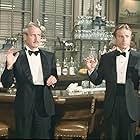
"The Sting" was devised as a follow-up to "Butch Cassidy", reuniting Newman and Redford as lovable, wisecracking rogues. The motivation behind the project may have been cynical box-office manipulation, but the resulting film is a beauty. The two stars make a great team, and multi-faceted confidence tricks adorn the plot in Byzantine complexity.
Lonnegan (Robert Shaw) has two prominent personality traits - greed and cruelty. A con is put together which will use these characteristics against their owner. The best way to hurt Lonnegan is to dupe him out of his money, because the sharks of the criminal fraternity will turn on him once they see that he's been 'had'. It is essential that Lonnegan must never know that this was a scam, because if he did, he would pursue a vendetta against our heroes. He must believe that he lost his money through his own stupidity, and that the men who took it are now dead.
The opening scenes emphasise the harshness of a world in which powerful crooks fleece ordinary joes, but also stress the warmth of the social bond which unites the small-time thieves. Mottola is a runner for Lonnegan's operation, a heartless dandy who steals a desperate man's dough (or so he thinks). The gambling dens ruthlessly swindle Hooker out of his money, but Hooker makes no trouble for the croupier, a guy just like himself who is merely trying to survive.
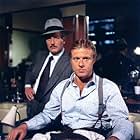
Redford plays Hooker to perfection. He is the handsome, charming 'man of the people'. There is no malice in him, and yet he spends his life ducking, diving and dodging lead. Luther was his father figure, and we see Hooker transfer his filial allegiance to Gondorff.
The film is crammed with technical cleverness. Whoever went out and scouted for locations did a great job, because the gritty 1930's look is wonderful. If the streets around the bookie's shop were 'faked' on a back lot, then this alone would make "The Sting" outstanding. Watch the urban period detail as Lonnegan goes across to place his first bet, and again at the start of "The Wire". Hooker suddenly realises that Luther is dead, and we see 'the penny drop' by means of a very simple but very effective device - the camera zooms back. No redundant dialogue, no over-acting. The panoramic view from above the rail tracks is achieved by 'masking in' a photograph of old Joliet, to create a convincing skyline. During the poker game on the train, the focus is thrown from Lonnegan's cards to Gondorff's eyes. We know that Gondorff knows that Lonnegan is cheating.
The music cannot go unmentioned. Apart from being exquisite, it contributes a major part of the film's overall feel. "The Sting" introduced the piano rags of Scott Joplin to a mass audience, and their popularity has not diminished over the ensuing decades. Composed perhaps forty years before the events they illustrate, and therefore 'wrong' from a period point of view, the pieces are none the less perfect, and the film is unimaginable without them. As a fun accompaniment to the music, the film contains various silent-era 'wipes'. Watch for the changes of scene for the iris-ins and iris-outs, and vertical and horizontal wipes.
David Ward's script is intelligent and intricate. The 'big con' has safety features built into it, such as the well-worked 'shut-out'. In order for the audience to take the swindlers to their hearts, it is necessary to depict the cops as venal, immoral and downright sleazy. Local dick Snyder is all of this, and more, his character being a masterpiece of dimwitted malevolence.
Eileen Brennan (Captain Lewis in "Private Benjamin") plays Billie, Gondorff's partner. She turns in a performance of cool assurance, one of the film's subtler treats. Charles Dierkop is simply marvellous as Floyd. This veteran of "Butch Cassidy" has hardly any dialogue, but he makes Floyd central to the film's comic purpose - and does it all with nuances of gesture. The FBI agents are great. Wearing straw boaters more than a decade after straw boaters ceased to be cool, and persisting with them even in torrential rain, the G-men are the archetype of Hooverian 'squareness'.
It may be fanciful, but are there passing references to Hitchcock's "Strangers On A Train"? The carrousel may be stretching a point, but what of Mottola's feet at the start, wearing Robert Walker's shoes?
"The Sting" is a splendid film. The plot may perform bewildering gyrations, Robert Shaw's Irish accent may be somewhat shaky, and Solino may be an assassin too far - but the whole of this complicated contraption works, and works well. I can recall, back in 1974, an excited cinema audience actually cheering and shouting at the screen.
"Seems worthwhile, doesn't it?"